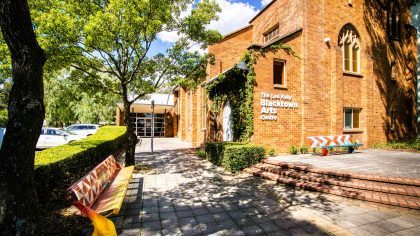
The Leo Kelly Blacktown Arts Centre
The Leo Kelly Blacktown Arts Centre is closed.

Bayadyinyang budyari Dharug yiyura Dharug Ngurra.
Bayady’u budyari Dharug Warunggadgu baranyiin barribugu.
Bayady’u budyari wagulgu yiyuragu Ngurra bimalgu Blacktown City. Flannel flowers dyurali bulbuwul.
Yanmannyang mudayi Dharug Ngurrawa. Walama ngyini budbud dali Dharug Ngurra Dharug yiyura baranyiin barribugu.
We acknowledge the Traditional Custodians of this Land, the Dharug people, and their continued connection to Country.
We pay our respects to Elders from yesterday to tomorrow.
We extend that respect to all Aboriginal and Torres Strait Islander Peoples of Blacktown City where the flannel flowers still grow proud and strong.
We will walk softly on this land and open our hearts to Country as the Dharug people have for tens of thousands of years.
Credit to: Dharug woman Rhiannon Wright, daughter of Leanne ‘Mulgo’ Watson Redpath and granddaughter of Aunty Edna Watson
Blacktown Arts Our Collections Blacktown City Art Collection Search the Collection Collection Details
Name/TitleEel Trap
About this objectArtists, weavers and Aboriginal cultural practitioners Steven Russell and Kristine Stewart each created an eel trap as permanent gifts to the Darug people. The traps were exhibited at the Blacktown Native Institution Corroboree on Saturday 7 November 2015, suspended between trees above the archaeological remains of the schoolhouse.
Prior to colonisation, a creek ran through the site of the Blacktown Native Institution. This watercourse was central to Darug life, trade and ceremony, as well as being home to eels which the Darug caught and ate. Darug people still remember when the creek ran, and how they ‘caught mussels, freshwater yabbies and fish’.1 Today, the chain of ponds that fed into Bells Creek exists only as a scar running across the site of the Blacktown Native Institution. As such, it was remarkable to see the old watercourse come to life with reeds and birds after heavy rains in winter. These reeds are still used for weaving by local practitioners and, along with dragonflies, have deep cultural significance to the Darug and their profound relationship with the site.
Russell and Stewart decided to create the traps given the significant cultural role of eels for Aboriginal people living on the East coast of New South Wales and across Australia. The name of the nearby city of Parramatta is derived from the Darug word Burramatta meaning ‘the place where the eels lie down’. Eels appear regularly in Aboriginal artwork, and traditional legends implicate them in the creation of a number of other watercourses, including the Parramatta River. Eels were a staple food for Darug people, caught by driving them upstream into traps and securing them using barriers made from river grasses.2
Russell and Stewart have a longstanding relationship with and commitment to the Blacktown area and a history of cross-cultural practice. Throughout the three events comprising the Blacktown Native Institution Project, Russell and Stewart led weaving workshops, creating spaces for learning and cultural exchange. They have also previously led a number of workshops through the Blacktown Arts Centre, developing a close relationship with the local community as part of their commitment to and desire to support the Darug. As members of South Coast Aboriginal arts group Boolarng Nangamai, Russell and Stewart engaged in exchanges of traditional knowledges with communities across Australia and internationally.
Russell’s trap, distinguished by its tight, traditional weaving technique is made from Lomandra grass sourced in Blacktown and native to the Cumberland Plain. Stewart’s technique is more contemporary, formed from a nest of loose looping curves. It was woven with vines and plants found near her home on the South Coast of NSW. A native species, running postmans vine, is used to make the body of the trap, and an introduced species, red hot poker, forms the handle. This combination of traditional and contemporary techniques, using local, native and non-native materials, evidences the resilience of Indigenous cultures and the ongoing exchange between Aboriginal and non-Aboriginal people.
By gifting the traps to the Darug people of Blacktown, the artists signal a renewed connection and solidarity between longstanding and continuous cultures, and honour the Darug people’s custodianship of the site.
MakerRussell, Steven
Maker RoleArtist
Date Made2015
Medium and MaterialsLomandra grass
Place MadeOceania, Australia
TechniqueWoven
Measurements20.5 h x 85 l x 21 diam cm
Named CollectionBlacktown City Art Collection
Credit Line© Steven Russell
Acquired 2015, Blacktown Native Institution project
Blacktown City Art Collection
Object TypeWeaving
Object numberBCC RUL 001

The Leo Kelly Blacktown Arts Centre is closed.

Blacktown Arts supports artists through annual opportunities across prizes, exhibitions, funding opportunities, and studio spaces for local creatives.

Explore Blacktown City’s rich arts and cultural collections.

Blacktown City’s annual acquisitive art prize open to artists across Australia, with a prize pool of over $23,500.
The Blacktown Arts website is not compatible with Internet Explorer. Please use a modern browser such as Chrome, Firefox, Edge, or Safari for the best experience.